
Introduction
Bonus dux bonum reddit comitem. Latin for `A good leader makes a good companion’. In Dutch we say `Een goed voorbeeld doet volgen’, which literally means `a good example is followed’. In this article I describe how Regionaal Opleiding Centrum Midden Nederland (ROC MN) followed a good example from Bochum University of Applied Science (BUAS) Germany. For direct or indirect learning-outcomes in this article I refer to the level of where impact is expected or measurable as described in the networkimpactmodel (Het netwerkimpactmodel ¹ , 2025; Krol, 2025). With direct learning outcomes I mean impact in the first ring. Indirect learning outcomes refer to the second, third and fourth ring.
Innovation Culture at ROC Midden Nederland
ROC MN is characterised by a positive and supportive school culture, where there is room for experimentation and making mistakes. This culture encourages teachers to try out new teaching methods. School leaders actively support this, which increases teachers’ willingness to embrace innovation. That said, resistance among teachers still exists. A lack of time, absence of a sense of urgency, and uncertainty about effectiveness are common sources of resistance.
Adapting a BUAS Assignment
The proposal to carry out a problem-based assignment from a university of applied sciences with vocational students did not immediately generate widespread enthusiasm among the VET teachers. At the time, the learning outcomes for students were not clearly visible. The example assignment was too large, too abstract, and too vague. By breaking the assignment down into smaller tasks and having vocational students work on them in a project-based format, support within the VET teaching team increased.
The Bobby Energy Hub
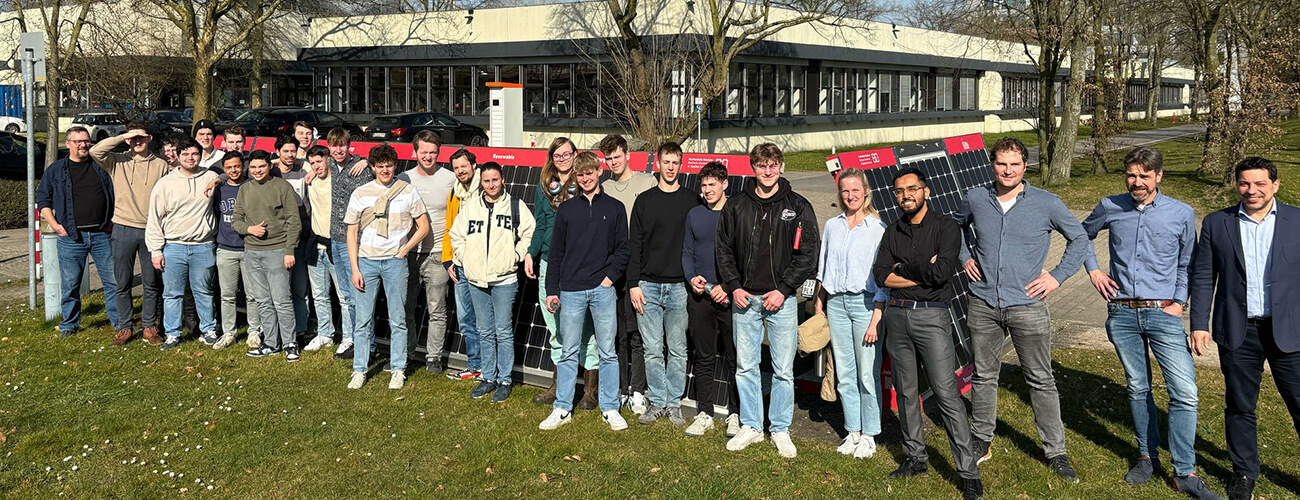
Since 2018, BUAS has been working on objectives aimed at promoting sustainable mobility, particularly in urban areas. Students are challenged to come up with innovative solutions in areas such as the ecological impact of shared mobility, battery efficiency in infrastructure, and new usage concepts for micromobility. These are important goals with societal impact. One of the solutions BUAS students came up with is the Bobby Energy Hub. A off-grid charging station for e-mobility such as e-bikes.


Impact on Vocational Education
Although societal issues are addressed within vocational education curricula, the primary focus remains on preparing students for their chosen profession. The vocational curriculum is geared towards qualification for the specific profession being trained for. The training criteria for these professions are outlined in qualification dossiers. If something is not included in the dossier, it generally does not appear in the curriculum. The BUAS assignment, which is also carried out by students from the University of Applied Sciences Utrecht, is—when viewed from the perspective of a vocational student—more focused on indirect learning outcomes. In particular, the potential societal impact is quite far removed from the learning outcomes that VET teachers aim to achieve with their students. Therefore, breaking the assignment down into smaller tasks tailored to the qualification profile of the student is a logical choice.
Student Collaboration and Leadership
The implementation of the Bobby Energy Hub project in the curriculum has led to a number of interesting consequences that can be described as impact in the second and third rings of the networkimpactmodel. A positive outcome was that the Engineering Technician (ET) level-4 student who created the design also supervised its execution. While this is part of the level-4 qualification, it is usually simulated by having level-4 students work together and guide one another. In this situation, however, the ET student actually led two level-3 construction students. Together, the three of them ensured that the basic frame of the Bobby Energy Hub was realized. At the time of writing, another ET student is working on the Bobby Energy Hub, now to design the electrical part.
Teacher Enthusiasm and Cross-Team Flexibility
In itself, the example above is not particularly extraordinary. What has been more remarkable is that several teachers became so enthusiastic that increasing flexibility is emerging within several educational teams to shape cross-team education. A great example is a colleague who is privately involved with the Thundu Foundation. The Thundu Foundation (Thundu, z.d.) is committed to giving children in Africa a future. This colleague teaches in a completely different team, working with level-2 and level-3 carpentry programs. During a coffee break, he proposed to the ET team an assignment to design and build a floating sports field so that children in Africa can play without the annual monsoon washing the field away. Thanks to the flexibility that emerged within ROC MN through among others the Bobby Energy Hub project, the Thundu proposal was immediately embraced and incorporated into the curriculum. At present, four ET students are working on the field design, after which level-2 and level-3 construction students will weld the field together.
Collaboration with HU University of Applied Sciences Utrecht
Another noteworthy example of impact, more toward the third ring of the impact model, is the development at HU University of Applied Sciences Utrecht. As mentioned earlier, HU students are working in parallel on the more social, societal, and entrepreneurial aspects of using the Bobby Energy Hub good practice. To carry out the research as is being done in Bochum, Germany, it is essential that the Bobby Energy Hub can be installed in the city of Utrecht. However, HU University of Applied Sciences Utrecht is not financially strong enough (especially now with severe budget cuts) to build the Bobby Energy Hub themselves. Therefore, HU approached a number of entrepreneurs who could have an interest in the Bobby Energy Hub. The fact that ROC MN students are already actively designing and building gives these entrepreneurs confidence that a prototype will be completed in the foreseeable future. This has proven to be a huge boost for the entrepreneurs to contribute to the process and the final outcome. In particular, the collaboration between HU University of Applied Sciences Utrecht and ROC MN has been received with great enthusiasm. Entrepreneurs emphasize the importance of future professionals learning from each other and being able to communicate effectively. They therefore actively encourage collaboration among the students.
The fact that students from different disciplines and levels need to work together has led to the creation of a professional learning community in which teachers from HU and ROC MN collaborate on developing a curriculum focused on integrated assignments across levels and disciplines. In addition, they are working on a suitable supervision model to ensure that the developed educational approach can be transferred to others.


Broader Lessons Learned
Bonus dux bonum reddit comitem. A good practice that leads to impact on different scales (rings) and in areas that were not initially considered. Sometimes we simply need to take action, rather than wanting to prepare everything perfectly in advance. And every now and then, it helps to pause and reflect—by writing an article like this, for example—to realize that we make (and can make) far more impact than we initially think. It is likely that with the Bobby E-hub good practice, we are creating much more impact than what is described here. Sometimes it is also in the small things. Enthusiasm among teachers and students alone is already an incredibly valuable form of impact. Let us not forget that.
¹ The Commoneye Netwerkimpactmodel is a Dutch framework designed to assess and strengthen the effectiveness of collaborative networks. While it is primarily practice-oriented, similar concepts and frameworks have been developed in international academic literature. This synthesis compares the Commoneye approach with three widely recognized scholarly contributions:
- Provan & Milward’s (1995, 2001): Network effectiveness model
- Provan & Kenis’s (2008): Modes of network governance
- Kania & Kramer’s (2011); Collective Impact framework Additionally, the role of Social Network Analysis (SNA) is highlighted as a methodological complement.
https://commoneye.nl/wp-content/uploads/Artikel-Netwerkimpactmodel.pdf
References
- Het netwerkimpactmodel. (2025). Het netwerkimpactmodel. https://commoneye.nl/wp-content/uploads/Artikel-Netwerkimpactmodel.pdf
- Krol, M. (2025, 16 september). Het Netwerkimpactmodel: effectiviteit inzichtelijk maken. Common Eye. https://commoneye.nl/het-netwerkimpactmodel-effectiviteit-inzichtelijk-maken/
Thundu. (z.d.). Thundu. https://www.thundu.nl/ - unknown. (2025). Handleiding netwerkimpactmodel [Handleiding]. In Handleiding Netwerkimpactmodel (p. 2). https://commoneye.nl/wp-content/uploads/Handleiding-Netwerkimpactmodel.pdf